Recursively self-improving to discover new knowledge.
To join the experiment, apply here.
Scroll for our manifestoLiving within the Experiment
The coming era of machine-driven scientific inquiry demands a new kind of research institution and a new kind of AI.
Using AI within legacy labs hampers the potential for breakthroughs, and leaves us susceptible to unnecessary ethical risks. Employing AI effectively and responsibly in service of discovery means rethinking the epistemic foundations of science and the social basis of creative collaboration.
Today’s AI excels at answering well-specified questions, and yet lacks meaningful ability to explore the open-ended world with curiosity and insight. AI that transforms invention must be equipped with deep aesthetic intuition over hypotheses, magnifying the agency of human scientists.
We believe that AI’s promise lies not in automating science, but in enabling a new kind of collective intelligence that leverages the comparative advantages of humans and machines. Realising this future means making a bet on a radical form of recursive self-improvement: one that operates safely across an entire institution.
Inherent will recursively self-improve to discover new knowledge.
Reinventing the Factory
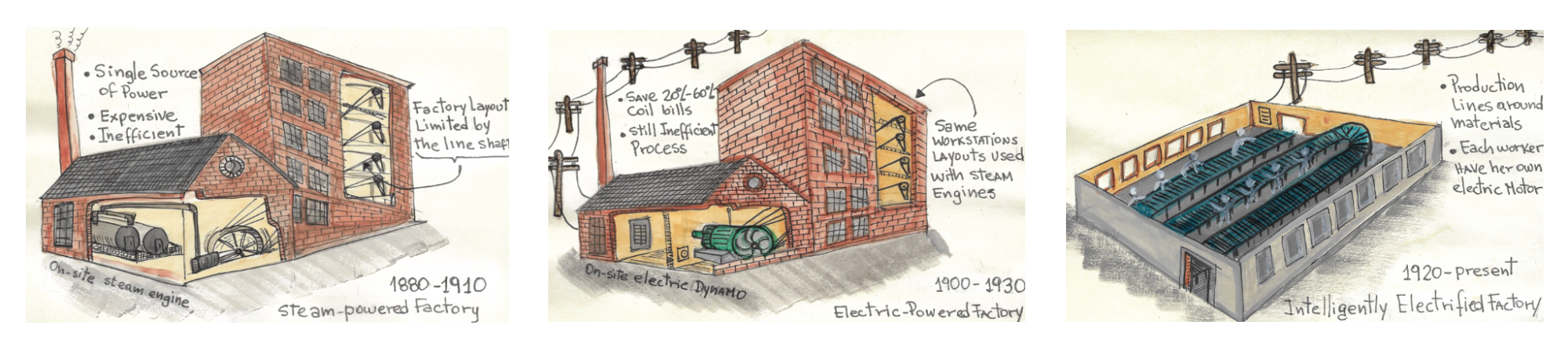
Imagine plucking a couple of experienced machinists from the 1890s and dropping them into a state-of-the-art factory in 1925. They would find the layout and pace of production disorienting. In place of giant machines connected by overhead line shafts to a central steam engine, they would encounter smaller machines, each powered by its own electric motor. When one device jams, our machinists would be surprised to see that the others carry on unaffected. Accustomed to keeping a wary eye on the hazardous line shafts, they look to the ceiling and now find skylights instead.
The technical innovation powering these changes was the electric dynamo. While dynamos existed in 1890, their potential remained underutilized for decades. Enthusiastic entrepreneurs, recognising that electrification was the future, used them to replace steam engines as centralized power sources, gaining marginal efficiency improvements. But to reap the full benefit of the new technology, they eventually had to redesign the factory.
Steam-driven factories had been organized vertically in multi-storey buildings to keep belt runs as short as possible. Once machines no longer needed to be tethered to a central, fixed infrastructure, they could be rearranged or replaced without shutting the whole factory down. Now it made sense to spread out laterally in a single storey, and with the ceilings freed from the load of deadly line shafts, the factory floor could be opened up and lit from above by windows in the roof. Factory owners came to realise that the dynamo’s great advantage lay in liberating production processes from the strictures of a centralized power source. Building design could follow the phases of production rather than the mechanics of power transmission.
At Inherent, we believe that the coming era of AI-driven scientific discovery requires process redesign at least as radical as the factory reconfiguration of the early 1900s. We cannot develop and employ powerful AI systems effectively and safely while constrained by workflows built for a different time.
If approached thoughtfully, AI-native organisational engineering could free us from the straitjacket of high modernist institutions, enable fairer collective decision-making, and increase human agency while eliminating drudgery. If handled carelessly, such transformation could, like the industrial revolution, increase productivity at the expense of workplace well-being. We have incorporated Inherent as a Public Benefit Corporation so that we can prioritise research that contributes to human society at large, even in situations where doing so does not maximise profit. Within the next six months, we will announce the membership and authorities of a societal-benefit board designed to ensure that we honour our commitments.
A New Aesthetic of Science
The adoption of new production techniques in the early 1900s offered a one-off boost in productivity. But the dynamo could not itself design a better dynamo. At Inherent, we are developing general-purpose inventive AI that accelerates research across domains and powers next-generation autonomous labs. This will in turn catalyse the redesign of R&D organisations, closing a feedback loop that continuously expands the collective capabilities of humans and machines.
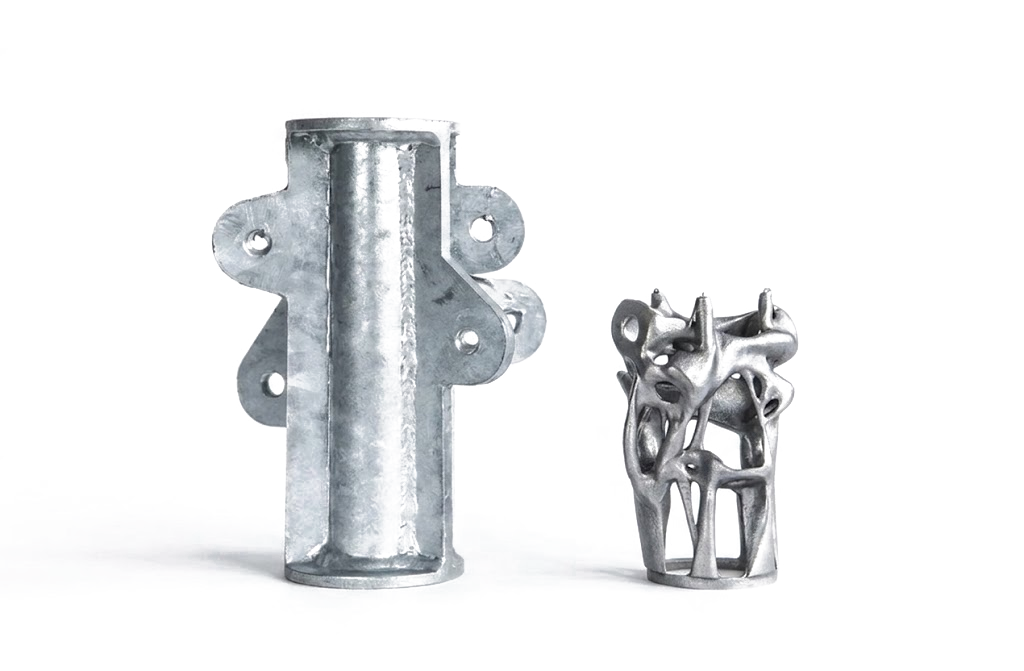
The construction joint on the right in the image above – a product of generative design – fulfills the same function as the human-designed joint on the left, but requires 75% less material. A priori, one might expect a high-performance structure to break down into simple geometric primitives. But reality – and what AI discovers within it – often proves much weirder.
In the early Enlightenment, the scientific method revolutionised how humanity acquired new knowledge. Iteratively developing empirically falsifiable theories supercharged our ability to answer the question “why”. From this philosophical seed has grown the collective wisdom that underpins modern science and technology and powers economic growth.
Recently, however, scientific progress has slowed. Ideas are getting harder to find, measured by the investment needed to discover a new drug, the number of scientists required per breakthrough, and the median age of Nobel laureates. Humanity has become a victim of its own success: the burden of existing knowledge becomes ever heavier, fragmenting disciplines and constraining creativity.
Luckily, we stand on the threshold of a new paradigm for scientific enquiry. Foundation models, in principle, can encode human knowledge without suffering the limitations of an individual human brain. The expanding scope of in silico research, coupled with the increasing automation of physical laboratories, is driving a sharp rise in capacity for high-throughput and low-latency experimentation. If equipped with scientific intuition, AI could densify and expand our understanding of the universe at unprecedented scale. Just as the strange joint above reflects a more holistic approach to design, capable AI Scientist agents will unify disciplines in unexpected ways.
With such tools, we can empirically study the scientific method itself. AI demands a re-examination of the philosophical foundations of discovery as profound as that which occurred during the Enlightenment. The science of 2036, replete with bizarre and beautiful new forms of human-machine teaming, promises a potential Cambrian explosion of perspective-shifting results.
At Inherent, we are on a mission to discover new knowledge. We seek to equip R&D teams across the globe with AI peers that augment creativity, accelerate innovation, and promote cooperation – a horizontal layer of generative design for all of science. Our models are designed not only to answer well-specified questions but also to elucidate which questions to ask. Blind optimisation of narrow metrics, whether at the level of an AI model or a human organisation, often proves counterproductive to breakthroughs and anathema to cooperation. Our agents will thrive in the open-ended arena of research, where prior experiments provide important epistemic clues, but there is no single best next hypothesis to test.
With science, as with institutional redesign, what matters is more than just the volume and quality of output. To preserve the joy of knowledge discovery, we must build systems that preserve human involvement and produce legible insights. The next scientific revolution rests on cultivating AI with curiosity, which, alongside humans, will uncover weird, wonderful and impactful insights. Exactly what form such insights will take is unknowable in advance, but exploring these possibilities requires an organisation dedicated to this new aesthetic of invention.
Recursive Collective Self-Improvement
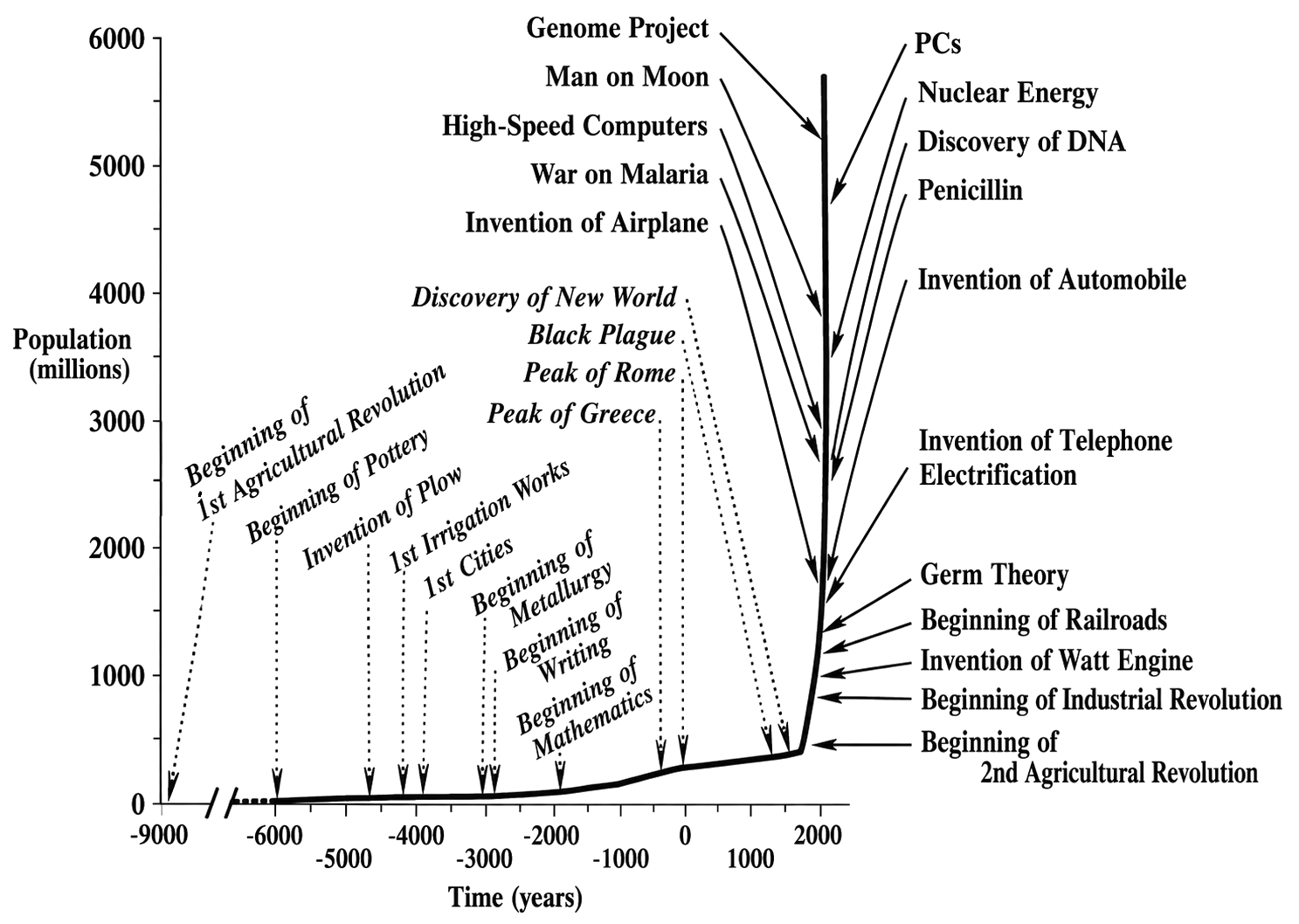
For 400 generations, humanity has enjoyed exponential growth in technological sophistication. We have built more effective tools to understand and control reality, and we have done so at increasing speed. Many foundational technologies have spread widely precisely because they enable a faster ratchet for tool invention: from writing, mathematics, and the printing press to the internet and large language models. The massively-parallel algorithm responsible for the remarkable success of our species, cultural evolution, is the archetypal example of recursive self-improvement (RSI): a system that improves its own ability to improve.
At Inherent, we view RSI as the meta-solution for reinventing scientific research. Inspired by cultural evolution, we apply RSI not at the level of an individual agent, but to our lab in its entirety. Advanced AI systems emerge from complex webs of research discussions, resource allocation, hardware infrastructure, training data and learning algorithms. AI is capable of advancing and accelerating research across all of these dimensions – enabling better collective decision-making, forecasting experiment outcomes, and optimising GPU kernels. These capabilities can compound, but only within an organisation designed from scratch around such recursive loops.
RSI, in other words, will reinvent the process of human-machine teaming as much as it will algorithms. The next-generation research organisation will have to stitch together two fundamentally different types of thinking, making the most of both human and AI capabilities. Cultivating this kind of collective intelligence will require innovation in designing both AI Scientists and the organisation around them.
Cultural evolution has a remarkable track record of interlinking technological progress with societal well-being and cooperation. Likewise, we operationalise RSI at the lab level to bind ethics and efficacy. By threading self-improvement through human-machine cooperation, we reap the benefits of rapid progress while keeping humans in control. And because every day at Inherent we ‘live within the experiment’; if our systems diverge from our values, we’ll be the first to feel, and fix, the pain.
We are building AI systems, an organisation, and a community that co-evolve to discover more about one another and the world. The unknown beckons; humanity’s latent potential is inherent.